Understanding MOQ
for Custom
Clothing.
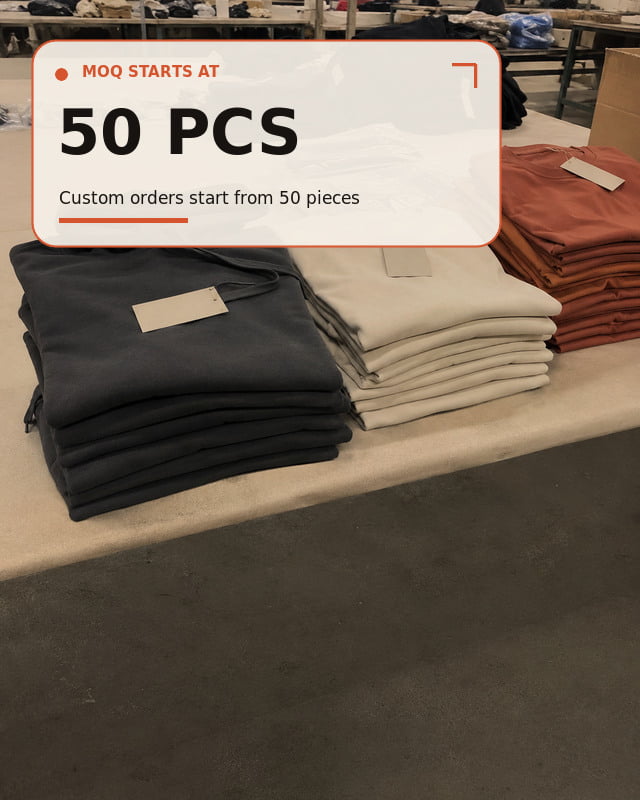
Minimum order quantity (MOQ) for custom apparel is not a single fixed number. The applicable MOQ for your project depends on the product, materials, decoration, and branding requirements -- and can only be confirmed after reviewing your specific details.
- MOQ is evaluated by product structure, fabric, and customization requirements.
- Different products and styles may require different minimum quantities.
- Accurate MOQ is confirmed after a full review of your project.
Yizhe Studio
Project-Based
MOQ Evaluation.
-- Materials & Structure
How Products, Fabrics
and Colors Affect MOQ.
The minimum order quantity for custom clothing production is shaped by multiple interconnected factors. Understanding how these elements interact helps set realistic expectations before development begins.
Product Category & Structure
The garment category and construction complexity directly influence how many units are practical per order. A simple cut-and-sew tee has different production dynamics than a multi-panel heavyweight hoodie or a structured denim jacket.
- Number of styles and SKUs per order
- Garment construction and panel complexity
- Size range per style
Fabric Selection & Color
Using stocked fabrics in standard colors gives the most flexibility for managing minimum quantities. Custom dyeing, special finishes, or matching colors across multiple fabric types and components add complexity that typically raises the practical minimum.
- Stock fabric vs. custom fabric development
- Available colorways vs. custom dyeing
- Fabric composition, weight and finishing
- Color matching across panels or sets
Key consideration: Using available fabrics in standard colorways generally makes it easier to manage minimum quantities. Special fabrics, custom color development, or multi-fabric matching typically require higher minimums per color or component.
-- Decoration & Branding
Decoration, Trims
and Packaging Requirements.
Custom decoration, branded trims, and packaging each carry their own minimum requirements from suppliers and production processes. The total applicable MOQ for a project reflects all of these components together.
Printing Techniques
Screen printing, DTG, puff print, rubber print, and other special effects each involve different setup requirements, screens, or plate preparation that factor into minimum run quantities.
View Printing OptionsEmbroidery & Appliqué
Flat embroidery, 3D puff embroidery, and appliqué work require digitizing or pattern setup. Minimum quantities vary based on stitch count, technique, and artwork complexity.
View Embroidery OptionsCustom Trims & Hardware
Custom zippers, buttons, drawstrings, eyelets, and metal hardware are often subject to supplier minimums independent of garment quantity. These minimums must be factored into the overall project plan.
View Trims & AccessoriesBrand Labels & Care Labels
Main labels, size labels, and care labels are typically woven or printed in dedicated production runs. Custom label designs are subject to their own minimums from the label supplier, separate from garment quantities.
View Custom LabelsHangtags, Bags & Packaging
Custom hangtags, printed polybags, stickers, barcodes, and branded cartons each carry supplier minimums. Packaging requirements vary by product and market, and should be confirmed during development.
View Custom PackagingImportant: The final applicable MOQ for your project must account for both garment production quantities and the minimum requirements of each custom material -- decoration, trims, labels, and packaging -- rather than the garment count alone.
-- Practical Considerations
Small-Batch Production
and Practical Options.
Small-batch production is not simply a reduced version of a larger order. The same development steps, material sourcing, setup, and production management apply regardless of quantity -- which means fewer units typically results in higher cost per piece.
Why Small Quantities Cost More Per Unit
Pattern Development & Sampling
Pattern making, fitting, and sample corrections are fixed development costs applied to every project, regardless of final order size.
Fabric & Trim Minimums
Fabric mills and trim suppliers maintain their own minimums. When garment quantities are low, sourcing costs per piece rise accordingly.
Cutting & Production Setup
Cutting, printing setup, and production line changeover carry fixed time and labor costs that are spread across fewer units in a small order.
Quality Inspection & Management
Quality control, measurement checking, and order management require the same attention to detail for every batch, regardless of unit count.
Ways to Optimize for a First Order
- Start with one core product rather than a full collection
- Reduce the number of colorways per style
- Use available fabrics and standard colors where possible
- Choose standard trims for the initial run
- Simplify highly complex decoration or special effects
- Use standard packaging for the first order
- Confirm the approved sample before expanding the collection
Note: A simpler first collection makes sampling, costing, and production significantly easier to manage -- and creates a reliable foundation for scaling future orders.
-- Project Submission
Send Your Project for
an Accurate MOQ.
The more complete the information you share, the more precisely we can evaluate the applicable MOQ and provide an accurate production assessment for your project.
What to Include in Your Enquiry
Product Type & Style Description
Garment category, construction details, and any specific structural requirements.
Tech Pack, Design Files or Reference Images
Any existing sketches, reference photos, tech packs, or physical samples you can share.
Estimated Quantity, Colors & Size Range
Your target order quantity, number of colorways, and required size range per style.
Fabric, Decoration & Branding Requirements
- Preferred fabric -- composition, weight, finish, or specific material references
- Printing or embroidery -- technique, placement, artwork files, and color specifications
- Custom trims and hardware -- zippers, buttons, rivets, drawcords, aglets, and other details
- Main labels, size labels and care labels -- material, print method, and branding artwork
- Packaging requirements -- hangtags, polybags, carton specifications, and any retail-ready requirements
Target Delivery & Destination
Your required delivery timeframe and destination country or region.
Upload Project Files
Submit your tech pack, artwork, sketches, or reference images together with your project details. Our team will review your requirements and respond with a clear production path and MOQ assessment.
Upload your project files
Tech packs, artwork, reference images, sketches, or any other files that help describe your project.
Upload Project Files →Upload your tech pack, artwork, or reference images through our Request a Quote form.
Now accepting new project enquiries. Share your references or tech pack and we will review your requirements and respond with a clear path forward.
Ready to start your custom
clothing project?
Streetwear · Casualwear · Sportswear · Denim -- OEM Manufacturing from Dongguan.