Size Tolerance
in Custom
Garment Production
A practical guide for clothing brands and bulk buyers -- covering why measurements vary, how we measure, and how we confirm size standards before and during production.
Size tolerance is not a single fixed number. Acceptable variance is confirmed according to the garment type, fabric, construction, finishing process, and agreed measurement points -- and is set per style before bulk production begins.
Key Topics
Measure.
Confirm.
Produce.
-- Section 01
Understanding Size Tolerance
in Clothing Production
In custom garment manufacturing, a certain degree of size variation between individual pieces is a normal and expected part of the production process. This does not indicate a quality failure -- it reflects the nature of working with fabric, thread, and handcraft at scale.
Acceptable tolerance is not a fixed universal number. It depends on the product type, fabric behavior, measurement point, construction complexity, and the size specifications confirmed before production begins.
Understanding what causes size variation -- and how to manage it -- helps brands and manufacturers align expectations and reduce disputes caused by inconsistent measurement standards.
Common Contributing Factors
Cutting Variation
Slight differences in blade angle, fabric layers, or marker placement during cutting can affect panel dimensions before sewing begins.
Sewing & Seam Allowance
Minor variations in seam allowance, stitch tension, and operator technique during assembly can influence finished dimensions at key measurement points.
Fabric Elasticity & Behavior
Knit fabrics, stretch wovens, and ribbing materials can shift or recover differently during sewing and pressing, affecting final measurements.
Pressing & Finishing
Steam pressing and ironing can cause fabric to relax or contract slightly, particularly on natural fibers, affecting measurements taken before and after finishing.
Garment Washing & Dyeing
Enzyme wash, stone wash, pigment dyeing, and other wet processes introduce dimensional changes that vary by fabric weight, construction, and wash intensity.
Manual Measurement Differences
How a tape is placed, how much tension is applied, and where exactly a point is located can produce different readings even on the same garment. Consistent method is essential.
-- Section 02
How We Measure
Key Garment Points
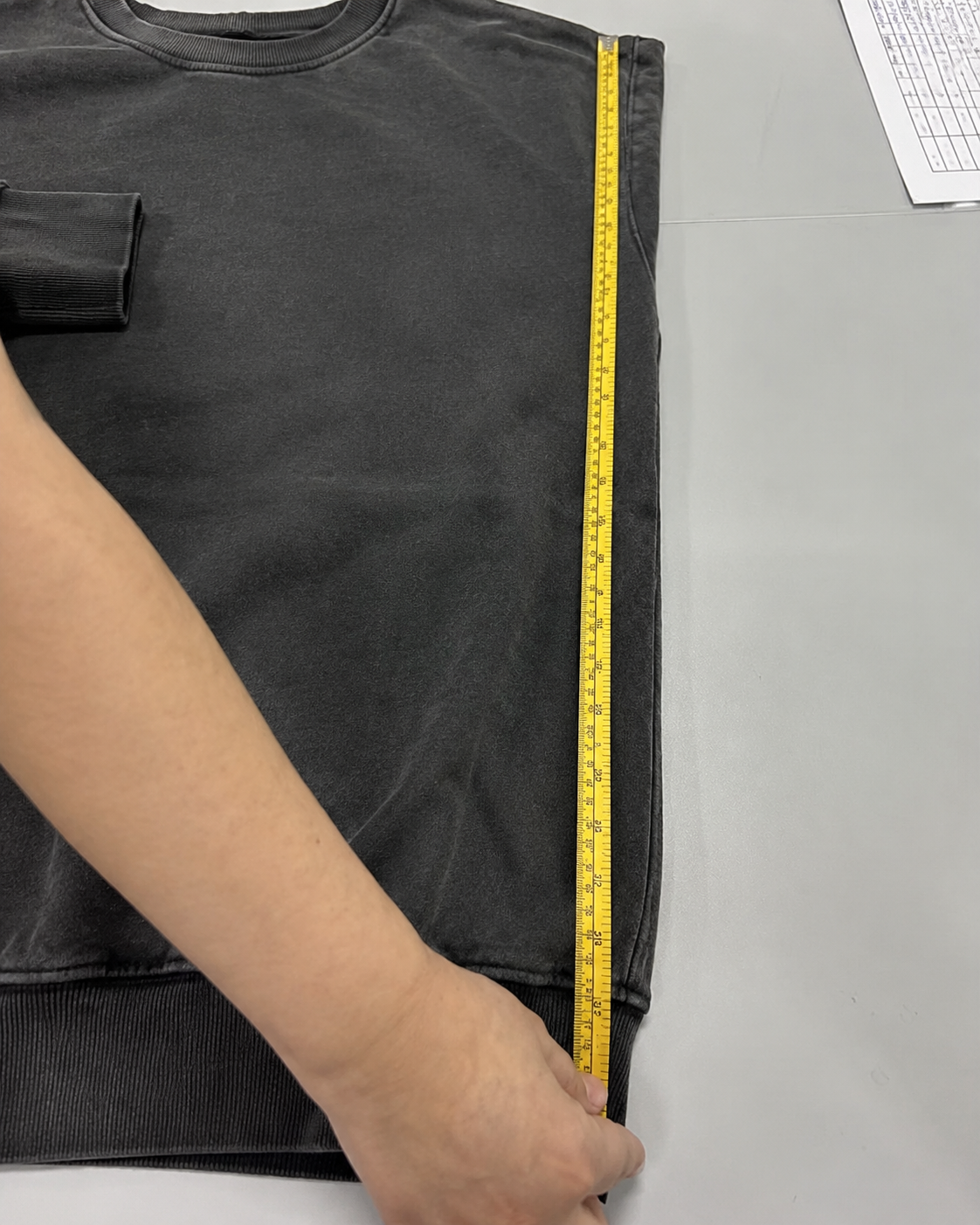
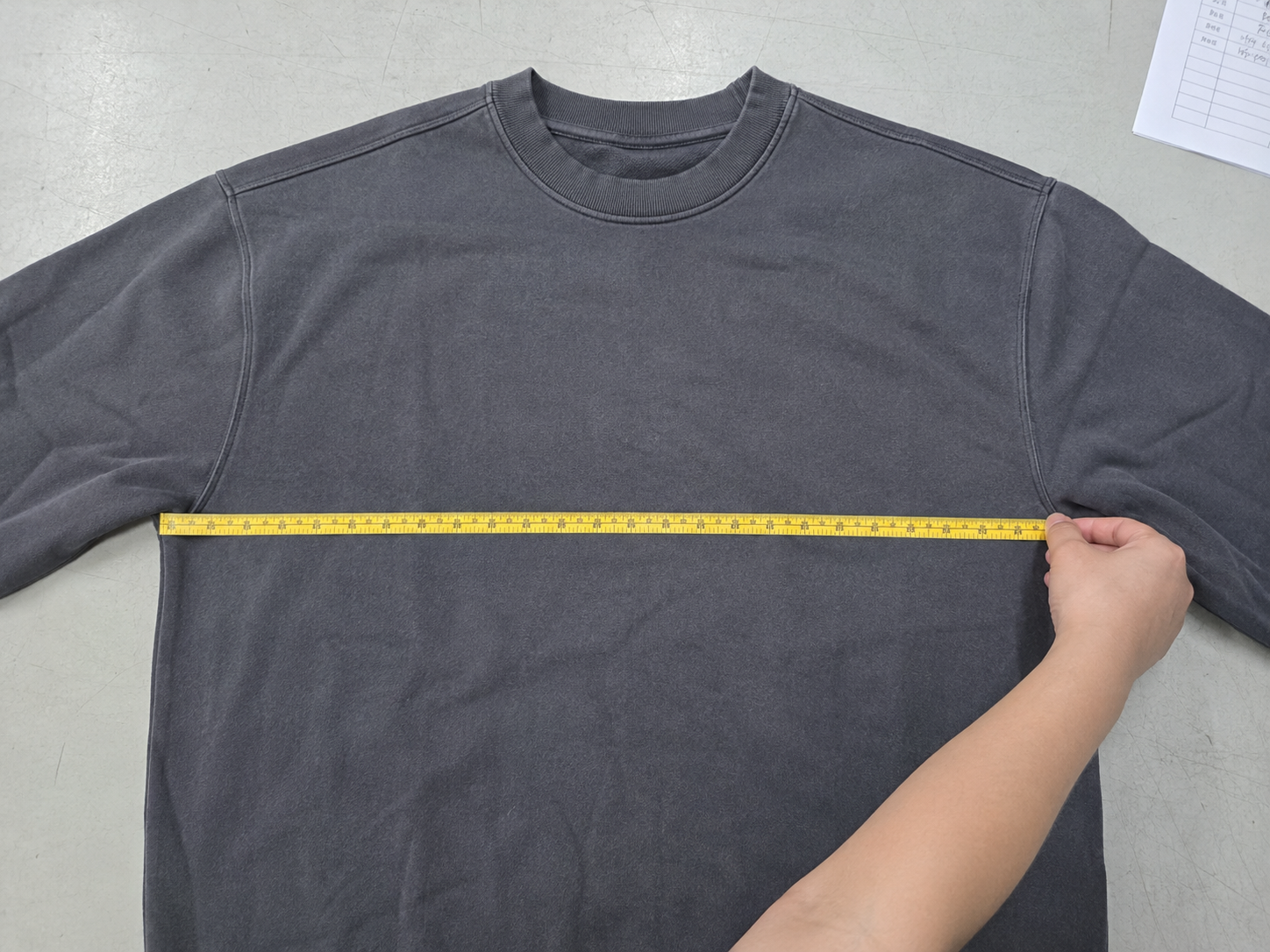
All measurements are taken on flat, unpinned garments using a standard tape measure. Consistent placement, consistent tension, and consistent garment position are required for comparable results.
Measurement Principle
Lay the garment flat on a clean, even surface. Smooth out folds without stretching. Measure from the specified start point to end point in a straight line unless otherwise noted in the spec sheet.
Common Measurement Points
Chest Width
Measured across the front, 1 inch below the armhole seam, from seam to seam. Garment laid flat, not stretched.
Body Length
From the highest point of the shoulder (or back neck seam) straight down to the bottom hem. Method must be consistent between sample and bulk.
Shoulder Width
From shoulder point to shoulder point across the back, measured in a straight line. Drop-shoulder styles require a clearly defined reference point.
Sleeve Length
From the shoulder seam (or specified start point) to the cuff edge. Confirm whether measurement includes or excludes the cuff band.
Waist Width
Measured at the waistband or defined waist point. For elasticated waists, specify whether to measure relaxed or fully extended.
Hip Width
Measured at the widest point of the hip. The distance from the waistband to the hip point must be noted consistently in the spec sheet.
Outseam / Inseam
Outseam from waistband top to hem. Inseam from crotch seam to hem. Both measurements should include or exclude the waistband as agreed.
Leg Opening
Measured across the bottom hem of one leg, laid flat. For ribbed or elasticated hems, specify whether to measure relaxed or stretched.
Important Note on Measurement Consistency
Both the client and factory must use the same starting point, the same garment position, and the same tape tension. A difference in method -- not a production error -- is frequently the cause of apparent size discrepancies.
-- Section 03
Fabric, Construction
& Wash Effects
Different fabrics and construction methods behave differently during production and finishing. Understanding these characteristics helps set realistic expectations for dimensional stability.
Fabric Characteristics
Knit Fabrics
Jersey, French terry, and fleece fabrics have inherent stretch in width and length. Measurements can vary depending on how much the fabric is relaxed before cutting and how it recovers after sewing.
Woven Fabrics
Woven fabrics such as twill, poplin, and canvas are generally more dimensionally stable than knits. However, they can still shrink or distort along the grain, especially after washing or steaming.
Stretch & Elastic Fabrics
Fabrics with spandex or elastane content can stretch significantly during sewing and recover after. Measurements must be taken in a fully relaxed state unless otherwise specified.
Ribbing & Trim Fabrics
Rib cuffs, waistbands, and neckbands have high stretch-and-recovery characteristics. Their finished dimensions depend on how tightly they are sewn onto the garment body.
Heavyweight Fabrics
Heavy fleece, thick cotton, and structured wovens tend to hold their shape well but can be more affected by pressing. Seam bulk at intersections may slightly alter local measurements.
Denim
Raw and washed denim both have significant shrinkage potential. Garment wash, enzyme wash, and stone wash processes can affect length, width, and seat measurements in different proportions.
Construction Effects
Panel Construction & Seaming
Multi-panel garments with curved seams, yoke joins, or side panels may show slight measurement variation at seam intersections due to sewing tension and panel alignment.
Elasticated Waistbands
Elastic tension, casing width, and how the elastic is attached all affect the relaxed and extended waist dimensions. Both states should be specified in the size chart.
Complex Pocket Structures
Cargo pockets, patch pockets with flaps, and welt pockets add fabric layers that can shift nearby seams slightly, affecting measurements at the hip or thigh area.
Drop Shoulder & Oversize Fit
Oversized silhouettes with dropped shoulders require clearly defined measurement points. Without agreed reference points, shoulder and sleeve measurements can vary significantly between measurers.
Garment Wash Effects
Enzyme & Stone Wash
These processes soften and distress fabric, causing shrinkage in both length and width. The degree of change depends on fabric weight, wash duration, and chemical concentration.
Pigment & Overdyeing
Dyeing finished garments can cause uneven shrinkage, particularly on seam areas and ribbing. Color absorption may also vary between fabric types in the same garment.
Acid Wash & Bleach Treatments
Chemical treatments can weaken fiber structure, making fabric more prone to dimensional change during and after the process. Measurements should be taken after all wash processes are complete.
Pre-wash vs. Post-wash Specs
For washed garments, size specifications should be confirmed based on post-wash measurements. Pre-wash measurements are used only for pattern adjustment, not as the final acceptance standard.
-- Section 04
Spec Sheet, Sample
& Inspection Workflow
Clear size documentation before production begins is the most effective way to prevent measurement disputes. The approved sample, size chart, and measurement method together form the production standard.
What Clients Should Provide
The approved sample supports fit and construction confirmation, while measurable dimensions are checked against the approved size chart and agreed POM method.
Approved Size Chart / Spec Sheet
A complete measurement table listing all required measurement points, values per size, and tolerances to be applied during production.
Tech Pack
Technical documentation including construction details, measurement diagrams, and workmanship specifications to guide pattern making and production.
Measurement Method or POM Guide
Instructions on how each measurement point should be taken -- including start/end points, garment position, and whether stretch applies.
Approved Sample or Reference Sample
A physical garment showing the target fit, construction, and finish. Used alongside the size chart to confirm bulk production standards.
Size Control & Inspection Workflow
Pre-Production Confirmation
- Review client-provided size chart, spec sheet, and POM method
- Confirm fabric, trims, and wash process requirements
- Develop sample and record measurements at all key points
- Submit sample with measurement report for client approval
- Finalize approved sample, size chart, and POM as the bulk production standard
In-Process Measurement Checks
- Check first-cut panels against confirmed pattern measurements
- Monitor sewing at key stages -- shoulder, side seam, hem
- Spot-check finished garments before and after washing
- Flag any systematic deviation for immediate review
- Adjust pressing or finishing parameters as needed
Final Garment Inspection
- Finished garments are checked according to the agreed inspection method and project requirements
- Compare against the approved size chart and confirmed POM method
- Note and address any out-of-tolerance results
- Inspect workmanship, loose threads, stains, and overall appearance
- Pack and ship only after inspection is completed
-- Section 05
Handling
Out-of-Tolerance
Situations
When a measurement discrepancy is identified, we follow a structured process to assess the situation and determine the appropriate course of action.
Align Measurement Method First
Before treating any discrepancy as a production defect, both sides re-measure using the same agreed method and reference points to confirm the actual measurement values.
Assess Affected Points & Quantity
We identify which measurement points are out of tolerance, how many garments are affected, and whether the issue is isolated or systematic across the batch.
Repair or Rework Where Possible
Garments with adjustable issues -- such as hem length, waistband take-in, or pressing corrections -- are reworked to bring them within the agreed tolerance range.
Communicate Issues Promptly
For issues that cannot be corrected through rework, we communicate the situation to the client promptly with measurement records and discuss the appropriate resolution together.
Our Approach
Clear size documentation and a confirmed sample before bulk production begins significantly reduces the likelihood of tolerance disputes. When issues do arise, we address them transparently and work toward a practical resolution.
Frequently Asked Questions
Common Questions
About Size Tolerance
Why can garment measurements vary slightly?
Does garment washing affect finished measurements?
How is the acceptable tolerance confirmed?
Why must both sides use the same measurement method?
What size information should clients provide?
-- Confirm Your Size Standards Before Production
Send us your size chart,
Tech Pack or reference
sample.
We'll review the measurement requirements for your project and confirm the size standards, measurement method, and inspection approach before production begins.
© Yizhe Studio -- Custom Apparel Manufacturing, Dongguan, China.
Made in Dongguan · Worn Worldwide